The most common mistake with an AWS Solutions Architect Associate study guide is reading it like a glossary. SAA-C03 rarely asks what a service does. It asks which option is cheapest, most resilient or least work for one specific scenario.
So study trade-offs instead. The SAA-C03 study plan below takes about 8 weeks at 10 to 12 hours a week, and it slots into the bigger path to becoming AWS certified.
There’s no prerequisite. If AWS is brand new to you, though, our Cloud Practitioner study plan is a gentler first month.
Passing that one first also earns a 50% voucher, and our breakdown of AWS certification costs shows how it cuts this exam to $75.
Last checked against the AWS docs on November 21, 2026.
| SAA-C03 fact | What AWS says |
|---|---|
| Exam code | SAA-C03 (no replacement announced as of November 2026) |
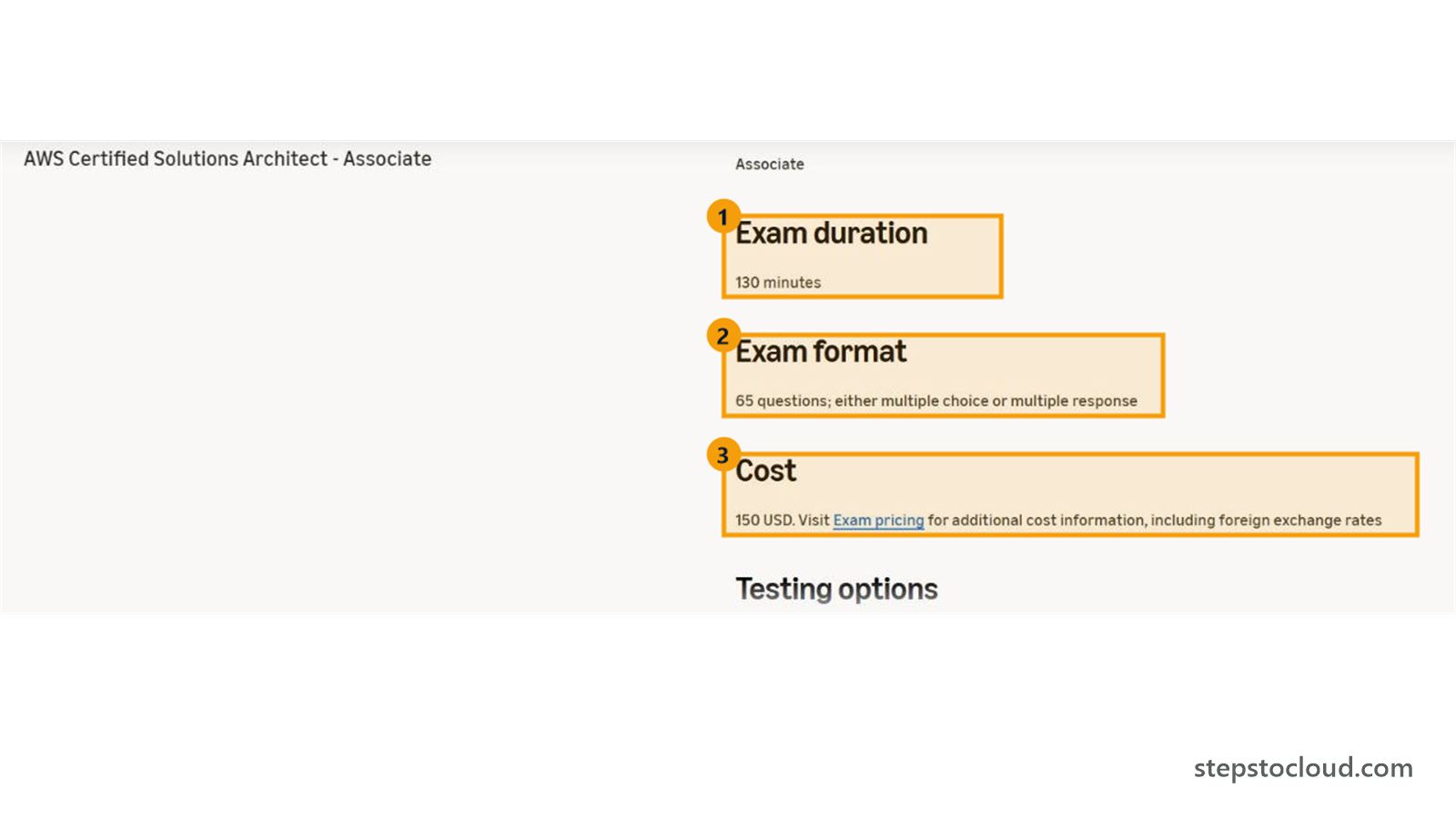
| Questions | 65: 50 scored + 15 unscored |
| Time | 130 minutes (+30 on request for non-native English speakers) |
| Passing score | 720 on a 100 to 1,000 scale |
| Price | 150 USD |
| Delivery | Pearson VUE test center or online proctored |
| Results | Within 5 business days |
| Valid for | 3 years |
This post contains affiliate links. As an Amazon Associate, Stepstocloud.com earns from qualifying purchases.
If you want a printed AWS Solutions Architect Associate study guide on the desk, the Sybex AWS Certified Solutions Architect Study Guide (SAA-C03) follows the exam outline and comes with 900 practice questions in its online test bank.

What does the SAA-C03 exam actually test?
Judgment. Every question is a short scenario with a constraint, and your job is to pick the best fit for that constraint. An option that merely works is usually a distractor.
You get 130 minutes for 65 questions, exactly two minutes each. Questions are multiple choice (one right answer of four) or multiple response (two or more right answers out of five or more).
Scoring is compensatory. You need 720 out of 1,000 overall, not a pass in each domain. There’s no penalty for guessing, and a blank counts as wrong, so answer everything.
Is SAA-C03 still the current version?
Yes. AWS has not announced a replacement as of November 2026, and both the exam page and the exam guide still point to SAA-C03. Ignore training sites selling “SAA-C04” material; none of them cites an AWS source.
What did change is the guide. Exam guide version 1.1, published October 29, 2026, removed Amazon Elastic Transcoder from the in-scope services. AWS says guide updates reach the live exam about a month later.
The guide also uses newer names: Amazon Quick for the BI service once called QuickSight, and Amazon SageMaker AI. Older courses still say QuickSight. Recognize both and move on.
How are the SAA-C03 exam domains weighted?
The official exam guide splits the scored questions across four domains. AWS doesn’t publish question counts per domain, so the third column is our estimate: weight times 50.
| Domain | Weight | Scored questions (est.) | What it covers |
|---|---|---|---|
| 1. Design Secure Architectures | 30% | About 15 | Access (IAM, Identity Center, STS, SCPs), workload protection (WAF, Shield, GuardDuty, Macie) and data security (KMS, ACM, Secrets Manager) |
| 2. Design Resilient Architectures | 26% | About 13 | Loose coupling (SQS, API Gateway, Lambda, Step Functions) and high availability (ALB, Route 53, RDS Proxy, DR strategies, RPO and RTO) |
| 3. Design High-Performing Architectures | 24% | About 12 | Storage, compute, database, network and data ingestion (S3, EBS, EFS, Auto Scaling, Aurora, DynamoDB, ElastiCache, CloudFront, Kinesis, Glue, Athena) |
| 4. Design Cost-Optimized Architectures | 20% | About 10 | Cheaper storage, compute, database and network choices (Spot, Reserved Instances, Savings Plans, Cost Explorer, NAT gateway vs NAT instance, VPC endpoints) |

Coach’s math: secure and resilient designs together make up 56% of your score on the AWS Solutions Architect Associate exam. If you can only get strong in two areas, make it those two.
The domain names mirror four Well-Architected pillars: security, reliability, performance efficiency and cost optimization. Operational excellence and sustainability have no domain of their own.
Which services answer each domain’s questions?
Every AWS Solutions Architect Associate study guide lists the domains. Fewer show which services tend to be the right answer, and which words in the question point to them.
| Domain | Services that win most questions | Words in the question that point there |
|---|---|---|
| Secure | IAM roles, STS, SCPs, Identity Center, KMS, Secrets Manager, WAF, Shield, GuardDuty, Macie, VPC endpoints | “least privilege”, “temporary credentials”, “encrypt at rest”, “rotate”, “SQL injection”, “DDoS”, “private access to S3” |
| Resilient | SQS, SNS, EventBridge, ALB, Auto Scaling, Multi-AZ RDS or Aurora, Route 53 failover, AWS Backup, Step Functions | “decouple”, “survive an AZ failure”, “RTO”, “RPO”, “no code changes” |
| High-performing | CloudFront, ElastiCache, DAX, read replicas, Aurora, DynamoDB, EFS, FSx, Global Accelerator, Kinesis, Athena | “low latency”, “read-heavy”, “millions of requests”, “real-time stream”, “query in place” |
| Cost-optimized | Spot, Savings Plans, Reserved Instances, S3 lifecycle rules, Intelligent-Tiering, Glacier classes, Lambda, Fargate, gateway endpoints, Compute Optimizer | “most cost-effective”, “interruptible”, “infrequent access”, “steady 1 to 3 year usage”, “reduce NAT or data transfer cost” |
For Domain 1, know IAM cold: roles instead of long-term keys, temporary credentials from STS, and SCPs as guardrails across accounts. Our introduction to AWS IAM covers the building blocks.
Which service pairs trip people up on the AWS Solutions Architect Associate exam?
Most wrong answers on SAA-C03 aren’t silly. They’re the sibling of the right service. If you only memorize one table from this AWS Solutions Architect Associate study guide, make it this one.
| Pair | The difference that decides the question |
|---|---|
| Security group vs network ACL | Security group: stateful, attached to an instance or network interface, allow rules only. NACL: stateless, subnet level, allow and deny rules. |
| RDS Multi-AZ vs read replica | Multi-AZ is for availability (a standby with automatic failover). A read replica is for read scaling and can be promoted by hand. |
| SQS vs SNS vs EventBridge | A queue consumers pull from (decouple, buffer) vs push-based pub/sub fan-out vs an event bus with rules and SaaS sources. |
| ALB vs NLB vs GWLB | Layer 7 HTTP routing vs Layer 4 TCP/UDP with static IPs and very high throughput vs inline third-party appliances. |
| CloudFront vs Global Accelerator | Caches HTTP content at the edge vs routes TCP/UDP over the AWS network with static anycast IPs and no caching. |
| EBS vs EFS vs FSx | Block storage for one instance in one AZ vs a shared NFS file system for Linux vs managed Windows, Lustre, ONTAP or OpenZFS file systems. |
| Gateway vs interface VPC endpoint | A free route-table entry for S3 and DynamoDB only vs a PrivateLink network interface for many services, billed by the hour. |
| NAT gateway vs NAT instance | Managed, scales, one per AZ vs an EC2 instance you run yourself (cheaper, but a single point of failure). |
| Direct Connect vs Site-to-Site VPN | A dedicated private line (consistent, slow to provision) vs an encrypted tunnel over the internet (quick to set up, variable performance). |
| Kinesis Data Streams vs Data Firehose | Custom real-time consumers with replay vs managed delivery to S3, Redshift or OpenSearch with near-real-time buffering. |
| Pilot light vs warm standby | Pilot light has to be switched on before it serves traffic. Warm standby serves at reduced capacity right away. |
| Savings Plans vs Reserved Instances vs Spot | A flexible dollars-per-hour commitment vs an instance-specific commitment vs discounted spare capacity that AWS can interrupt. |
| DataSync vs Storage Gateway vs Snow Family | Online one-time or scheduled transfer vs ongoing hybrid access to cloud storage vs offline bulk shipping when bandwidth is short. |
| Secrets Manager vs Parameter Store | Built-in automatic secret rotation vs simple configuration and secret storage. |
The disaster recovery pair deserves a second look, because Domain 2 leans on RTO and RPO. The AWS whitepaper is blunt: a pilot light can’t serve traffic until you switch it on, while warm standby can.
Our guide to AWS disaster recovery strategies walks through all four, from backup and restore to multi-site active/active, with the RTO each one buys.
Two more pairs cost people marks every sitting. Security groups versus NACLs is covered in our AWS VPC security best practices.
And for SQS versus SNS, our Amazon SQS explainer shows why a queue, not a topic, is the answer when a question says “decouple and buffer”.
How should you schedule this AWS Solutions Architect Associate study guide?
Budget about 85 to 95 hours over 8 weeks for this SAA-C03 study plan. The hours follow the domain weights, so security and resilience get the most time and cost optimization gets one focused week.

| Week | Focus | Domain | Hours | Build this | Checkpoint |
|---|---|---|---|---|---|
| 0 (one day) | Setup and baseline | All | 2-3 | Free Tier account, budget alarm, MFA on root | Free 20-question set, taken cold |
| 1 | IAM, STS, Identity Center, Organizations, SCPs, Control Tower | D1 | 11 | A least-privilege role; an SCP that denies | 20 domain questions |
| 2 | VPC, subnets, security groups vs NACLs, NAT, endpoints, WAF, KMS, Secrets Manager | D1 | 12 | A two-tier VPC with a private subnet and NAT | 25 questions |
| 3 | SQS, SNS, EventBridge, Step Functions, API Gateway, Lambda, ECS, Fargate | D2 | 11 | SQS queue feeding a Lambda function | 20 questions |
| 4 | Load balancers, Auto Scaling, Multi-AZ, Route 53 routing, DR strategies | D2 | 12 | ALB plus Auto Scaling group across two AZs | First full timed mock |
| 5 | S3 classes and lifecycle, EBS, EFS vs FSx, RDS vs Aurora vs DynamoDB, ElastiCache | D3 | 11 | S3 lifecycle rule and a DynamoDB table | 25 questions |
| 6 | CloudFront, Global Accelerator, Direct Connect, Transit Gateway, Kinesis, Glue, Athena, DataSync | D3 | 11 | CloudFront in front of S3 | Second full mock |
| 7 | Spot, Reserved Instances, Savings Plans, Cost Explorer, Budgets, NAT and data transfer costs | D4 | 10 | Tag resources; build a Cost Explorer report | Third mock, aim for 75%+ |
| 8 | Weak domains, the pairs table, Well-Architected pillars | All | 8-10 | Reread mock explanations | Final mock 80%+, then sit the exam |
Start the SAA-C03 study plan by taking the free 20-question set cold on day one. A bad score is useful, because it tells you which domain to fear before you’ve spent a single hour.
The first full mock lands in week 4, halfway through, on purpose. You want the shock early, while there’s still time to fix it.
Nothing new in the last two days. Picking up unfamiliar services right before the AWS Solutions Architect Associate exam is a classic trap; reread the pairs table instead.
Week 8 is also the time to reread the six pillars of the Well-Architected Framework, since four of them became the exam domains.
The Well-Architected Tool is free in the console if you want to review a lab design against them.
How do you shorten or stretch the SAA-C03 study plan?
With a year of AWS work behind you, compress it to 6 weeks by merging weeks 1 and 2, then weeks 6 and 7. Brand new to AWS? Stretch it to 10 to 12 weeks rather than cutting the labs.
Community answers run from two weeks for people who use AWS daily to about three months. A month to eight weeks is the most common. None of these numbers comes from AWS.
What should you build while you study?
AWS’s own Solutions Architects suggest roughly 80% building and 20% studying. Reading about a NAT gateway and watching a private instance fail to reach the internet without one are very different kinds of memory.
Labs are cheaper than they used to be. New accounts on the AWS Free Tier get $100 in credits up front, plus up to $100 more, on a free plan of up to six months.
Set a budget alarm and MFA on the root user before anything else. Then try the week 3 lab from the CLI: a queue you can send to and read from.
aws sts get-caller-identity
aws sqs create-queue --queue-name saa-orders-example --region us-east-1
aws sqs send-message --queue-url https://sqs.us-east-1.amazonaws.com/123456789012/saa-orders-example --message-body "order-1001" --region us-east-1
aws sqs receive-message --queue-url https://sqs.us-east-1.amazonaws.com/123456789012/saa-orders-example --region us-east-1
aws sqs delete-queue --queue-url https://sqs.us-east-1.amazonaws.com/123456789012/saa-orders-example --region us-east-1
Swap in your own account ID from the first command. Then notice that receive-message doesn’t remove the message. It comes back after the visibility timeout unless you delete it.
That one behavior sits behind the exam’s questions about duplicate processing and messages that “keep reappearing”. Seeing it once beats reading about it three times.
Which SAA-C03 resources are free, and which are worth paying for?
A solid SAA-C03 study guide can be built from free material alone, and some people pass that way. Paying mostly buys more realistic practice questions, which matter most in the final three weeks.
| Resource | Cost | What you get | Use it in |
|---|---|---|---|
| SAA-C03 exam guide (HTML or PDF) | Free | Domains, task statements, in-scope and out-of-scope services | Week 0, then week 8 |
| Official Practice Question Set | Free | 20 questions written by AWS, with detailed feedback | Week 0 baseline |
| Exam Prep course (standard) | Free | About 2 hours covering each domain and sample questions | Week 1 |
| Well-Architected Framework and Tool | Free | The six pillars; the Well-Architected Tool costs nothing in the console | Weeks 1 and 8 |
| AWS Free Tier | Free credits | $100 up front plus up to $100 more, on a free plan of up to 6 months | Every lab |
| Skill Builder subscription | From $29 a month | Official Practice Exam, enhanced Exam Prep course (6 to 8 hours of video, labs, extra questions), Cloud Quest Solutions Architect role | Weeks 6 to 8 |
Read the SAA-C03 exam guide’s in-scope services list before any course. By our count it names about 119 services in 16 categories, and it doubles as the checklist for week 8.
Skill Builder’s individual plan starts from $29 a month. One month timed for weeks 6 to 8 covers the Official Practice Exam and the enhanced course, so there’s little reason to subscribe on day one.
Outside AWS, the courses people credit most are Stephane Maarek’s and Adrian Cantrill’s (deeper and more hands-on). Tutorials Dojo is the most-mentioned mock exam source. Pick one course; buying two is a way to put off practice.
How should you use SAA-C03 practice tests?
On any SAA-C03 study plan, a mock exam is a diagnostic, not a score to feel good about. Run each one like this:

- Take it timed: 65 questions, 130 minutes, no notes, no pausing.
- Review for about twice as long as the test took. Read the explanation for every question, including the ones you got right.
- Log each miss by domain and by reason: didn’t know the service, misread the constraint, or picked the sibling.
- Re-study only your weakest domain before the next mock.
- Book the exam once you score 80% or more on questions you haven’t seen before.
Once you’ve used up the free AWS set, you need fresh questions. Neal Davis’s AWS Certified Solutions Architect Associate practice tests give you 390 SAA-C03 questions, enough for several clean timed runs.
Mock scores don’t transfer perfectly. Some people find the real AWS Solutions Architect Associate exam harder or worded differently, which is why the “misread the constraint” column in your log matters more than the score.
Which words in a question point to the answer?
| If the question says… | Lean toward… |
|---|---|
| “Least operational overhead” | Managed or serverless options such as Lambda, Fargate or DynamoDB |
| “Most cost-effective” | Spot, Savings Plans or S3 lifecycle rules |
| “Decouple” | SQS |
| “Static IP” plus global users | Global Accelerator |
| “Without changing application code” | RDS Proxy, ElastiCache, a read replica or a load balancer |
| “Temporary access” | STS and IAM roles |
| “Audit configuration compliance” | AWS Config |
| “Who did what” | CloudTrail |
These are leanings, not rules. Read the constraint first, then check the cue still fits the rest of the scenario.
How do you pass the AWS Solutions Architect Associate on exam day?
- Budget two minutes a question. Take a first pass at about 90 seconds each, flag anything long, and come back with the time you banked.
- Read the last sentence first. “Most cost-effective” and “most resilient” lead to different answers for the same architecture.
- Cut the two weakest options, then test the last two against the constraint word by word.
- On multiple-response questions, the question tells you how many to pick. Pick exactly that many.
- Never leave a blank. Guessing costs nothing.
Non-native English speakers can request 30 extra minutes for the English exam. You ask once in your AWS Certification account before you register, not on the day.
You can reschedule up to 24 hours before the AWS Solutions Architect Associate exam, at most twice per appointment. Cancel later than that, or don’t show up, and you lose the fee.
Testing online? English-speaking proctors are available around the clock, and they check your desk and room before you start, so clear both. Planning to take it in Italian? That version retires after December 31, 2026.
The fee is set in US dollars. If you pay in pounds, Canadian dollars or Australian dollars, AWS’s exam pricing page lists the exchange rates and any other costs.
What happens if you don’t pass?
You’ll need to wait 14 calendar days before a retake, and every attempt costs the full fee. There’s no limit on attempts.
Use those two weeks on the domains your mock log flagged, then take one fresh timed mock before you rebook.
What happens after you pass?
Results land in your AWS Certification account within five business days. The certification is valid for three years. You renew by passing the latest version of this exam or by earning the Professional certification.
You can’t retake a passed exam for two years, so there’s no going back for a higher score. Spend the 50% voucher on your next exam instead: Solutions Architect Professional, or another associate such as Developer.
Is it worth it for your career? The badge doesn’t map to one job title. For a related role, the BLS reports that computer network architects earned a median $134,050 in May 2025.
The same BLS page projects 8% job growth for that role from 2025 to 2035. The certificate opens the conversation; the VPCs and queues you built while studying are what you’ll actually talk about.

Solutions Architect Associate study guide (Sybex)
Follows the SAA-C03 outline, with 900 practice questions, flashcards and a glossary in the online test bank.
Check price on AmazonSAA-C03 practice tests (Neal Davis)
390 practice questions, a second bank for weeks 6 to 8 once the free AWS set is used up.
Check price on AmazonFrequently asked questions
How long does it take to study for the AWS Solutions Architect Associate exam?
Most people need six to ten weeks. The plan in this guide budgets about 85 to 95 hours over 8 weeks at 10 to 12 hours a week. With a year of AWS work you can compress it to 6 weeks; if AWS is new to you, stretch it to 10 to 12 weeks instead of skipping labs.
Is the AWS Solutions Architect Associate exam hard?
It’s harder than Cloud Practitioner because every question is a scenario where several answers would work. You have to pick the best one for a stated constraint, such as lowest cost or least operational overhead. Networking, disaster recovery and look-alike services catch the most people out.
Do I need the Cloud Practitioner before the Solutions Architect Associate?
No. SAA-C03 has no prerequisite, although AWS recommends about a year of hands-on experience designing cloud solutions. Cloud Practitioner is a gentler start if AWS is new to you, and passing it gives you a 50% voucher that brings the 150 USD Associate fee down to $75.
What is the passing score for SAA-C03, and how many questions count?
You need a scaled score of 720 out of 1,000. The exam has 65 questions in 130 minutes, but only 50 are scored; the other 15 are unscored trial questions you can’t identify. Scoring is compensatory, so you don’t need to pass each domain, and there’s no penalty for guessing.
Is SAA-C03 still the current version, or is there an SAA-C04?
SAA-C03 is still current. AWS has not announced a replacement as of November 2026, and the official exam guide is on version 1.1, published October 29, 2026, which removed Amazon Elastic Transcoder from the in-scope services. Check the AWS certification Coming soon page before you book.
What happens if I fail the SAA-C03 exam?
You must wait 14 calendar days before retaking it, and each attempt costs the full exam fee. There’s no limit on the number of attempts. Use the gap to rework the domains your practice tests flagged, then take one fresh timed mock exam before you rebook.
Conclusion
SAA-C03 rewards people who can pick the best design for a constraint, not people who can recite definitions.
That’s how to pass AWS Solutions Architect Associate: put your hours where the weights are, build as you go, and let timed mocks tell you when you’re ready.
- 65 questions (50 scored) in 130 minutes, 720 out of 1,000 to pass, 150 USD.
- Domains: Secure 30%, Resilient 26%, High-Performing 24%, Cost-Optimized 20%.
- Learn the confusing pairs; most wrong answers are a sibling of the right one.
- Plan about 85 to 95 hours over 8 weeks, with the first full mock in week 4.
- SAA-C03 is still current, and exam guide version 1.1 dropped Elastic Transcoder.
Recommended reading
- AWS Well-Architected Framework and its six pillars
- AWS high availability architecture
- AWS Elastic Load Balancer types compared
- What is Amazon S3?
- What is DynamoDB?

I am an Amazon Web Services Professional, having more than 11 years of experience in AWS and other technologies. Extensively working in various AWS tools like S3, Lambda, API, Kinesis, Load Balancers, EKS, ECS, and many more. Working as a Solution Architect and Technology Lead for Architecting and implementing the same for different clients. He provides expert solutions around the world and especially in countries like the United States, Canada, United Kingdom, Australia, New Zealand, etc. Check out the complete profile on About us.